

The Dutch space industry can start building the 45-million euros Tropomi, an important instrument for a new European climate satellite. Tropomi will measure the constituents of our atmosphere with dazzling precision and resolution.
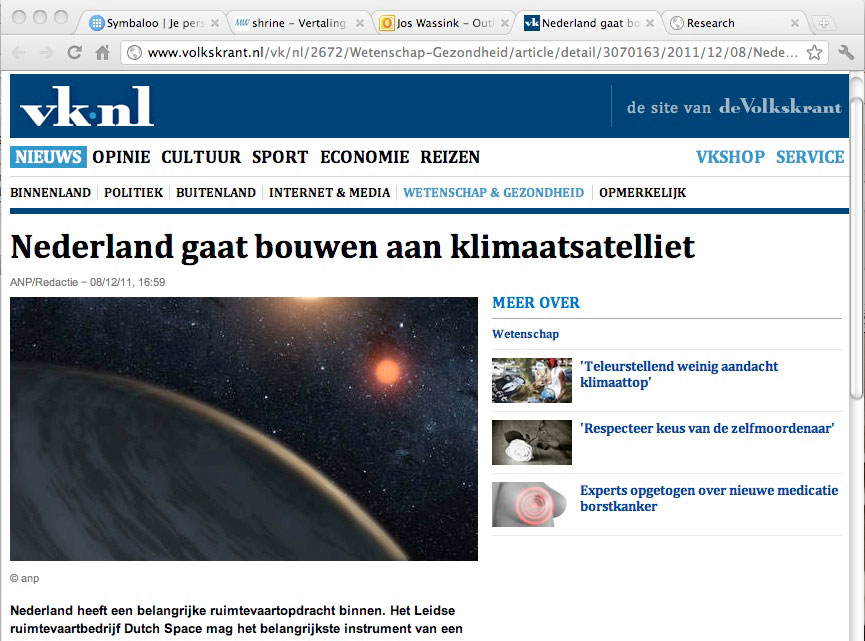
Tropomi will be able to study pollution with a stunning 7 by 7 kilometre resolution and hence locate the sources of pollution. The original decision to build the instrument was taken in 2008, but the contract was signed only last week. Dutch Space is the main contractor, and Dutch research institutes TNO and SRON are also involved. The Royal Dutch Institute for Meteorology (KNMI) is the principal scientific researcher. How important is this contract for the Dutch space industry?
“This is one of the most important orders of the last years for the Netherlands,” says professor of astrodynamics and space missions, Boudewijn Ambrosius. “It’s a highly advanced instrument. The Netherlands is a rather small player in the international space business, but we’ve made quite a name with complex and advanced instruments. With this order, Dutch industry can once again show how good we are.”
Tropomi’s goal is to collect data of the Earth’s atmosphere. “These will help to better understand the mechanisms of climate change,” Ambrosius explains. “As scientists, we like to have as much data as possible for study. Tropomi will collect data of trace gasses that are barely detectable but may play a role in global warming. This will be very useful.”
Dutch Space built two predecessors of Tropomi: Sciamachy (2002) and OMI (2004). The most important advancement will be the Tropomi’s data density. “Tropomi has a resolution that will be four times higher than its predecessors,” says former TU scientist, Rob Hamann, who, after his leaving the faculty of aero-
space engineering, set up the company SEc2, which is now involved with Tropomi.
The technology must be state of the art. “The instrument should detect methane, because it’s a greenhouse gas,” Hamann says. “We measure methane in the infrared part of the spectrum, but that is a problem because of heat generated by the instrument itself. We therefore need to cool the detector to 135 Kelvin with a radiant cooler. The temperature should be very stable and can only vary 30 milliKelvin.”
The high resolution data provided by Tropomi will tantalize scientists, making it possible to see exactly what sources cause pollution. With images measuring 7 by 7 kilometres, one can see for example if pollution above Rotterdam is caused by the highway or a part of the port. The Dutch government has recently made public that the speed limit on half of the highways will increase from 120 to 130 kilometres an hour. “With Tropomi we may see how much more pollution this causes,” says coordinator of national projects, Harry Förster, at the Netherlands Space Office, the governmental space agency.
The instrument will be launched on the ESA satellite, Sentinel-5p, in 2015. “It will be active for seven years,” Förster adds. “After that the Netherlands would love to build the next generation instrument for the successor of Tropomi.”
The Netherlands currently invests about 100 million euros annually in ESA and receives about the equal amount in orders for Dutch industry. However, the Dutch government threatens budget cuts. Förster: “Many politicians do recognize the importance of climate change but are not familiar with what it takes to maintain expertise to make advanced, highly complicated instruments. It’s important that we can continue to maintain this expertise after Tropomi.”


Comments are closed.