
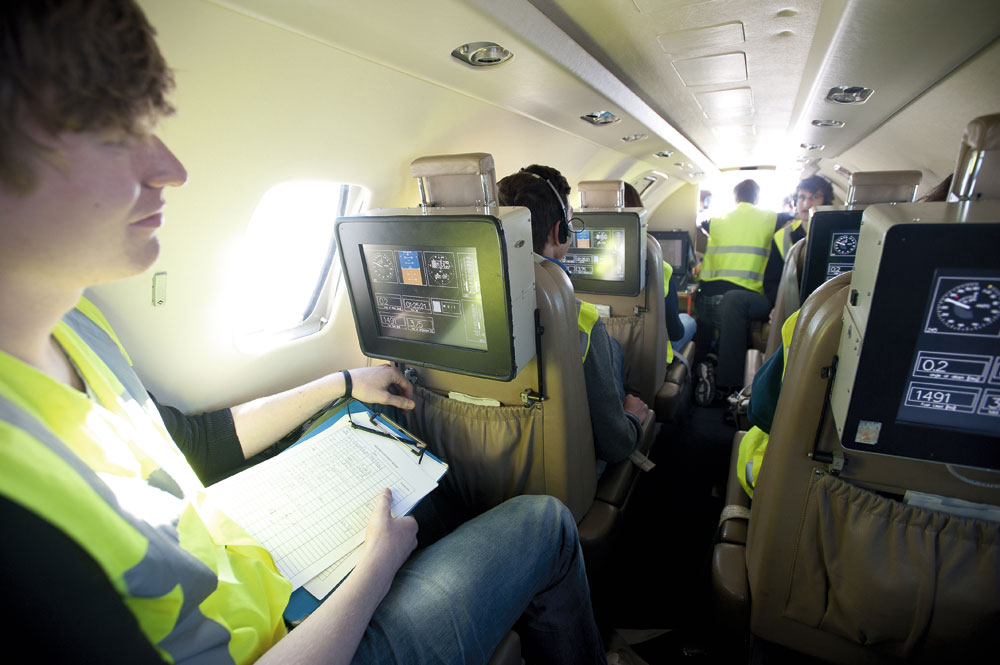
How better to grasp the dynamics of a flying airplane than to actually experience them? Dozens of students went up in the air in recent weeks with the TU Delft research airplane.
Delen
“The military wants to do some kind exercise with F16 fighter planes,” says pilot Dr Xander in ’t Veld. “That’s why we have to go further to the east, all the way to Twente. Hmm…they’re really sending us far away.”
Finally the Cessna citation research airplane (owned by TU Delft and the National Aerospace Laboratory) is flying in a military zone where the pilots are allowed to do all kinds of caprioles. The five students (from AE faculty) on board all have a computer screen in front of them that provides information about speed, position of the rudders, flaps and the various forces at play.
“Of course you can study the behaviour of a plane by solving differential equations,” says In ’t Veld. “But once the students are in the air the penny drops. Here they really get to grasp the dynamics.”
In ’t Veld’s explanation about the importance of this yearly practical course for AE students is suddenly interrupted by his colleague, pilot Hans Mulder. “Okay, we’re stationary again guys”, he shouts. “Gogogo…” The students all start making notes.
When asked if he sometimes plays tricks on the students, Mulder replies that he and his colleague are “not fooling around in the air”. Whereupon he warns me that I should get hold of something. “Yes,” says In ’t Veld, “we’re about to mimic the situation which caused the crash of the Turkish Airlines plane a while ago. Don’t worry, at this altitude nothing can happen to us.”
The students, with bright smiles on their faces, are clearly pleased with what is about to happen. As the pilots reduce speed the air flow separates from the wing and the plane starts shaking heavily.
“It’s cool to see that what we learned in theory is correct,” says student Tim Neefjes. “The coolest thing about this practicum however is the parabolic flight where you come to be in a condition of weightlessness.”
Unfortunately that state is not meant to be on this specific flight, as one of the students gets sick a little later during the spiral plunge. “Too bad,” says Mulder, “I don’t want to make the parabolic flight with a bag of vomit floating around in the cabin.”
“Stilte!” galmt het door de hoge gangen van het Science Centre. Het valt niet mee om je hier verstaanbaar te maken boven het geroep en gegil van honderd uitgelaten scholieren. De leerlingen hebben er om half tien ’s ochtends al een flinke reis opzitten. Vanochtend vroeg zijn ze met drie vwo-3 klassen van de Piter Jelles
Aldlân school vanuit Leeuwarden vertrokken om een bezoek te brengen aan de TU Delft in het kader van het ‘preprofiel project’. “U mag het een lelijk woord vinden”, reageert Marianne Lander-Brakel, “maar het dekt de lading wel. Het is een kennismaking met de TU voor leerlingen van 3-vwo die hun profielkeuze nog moeten maken.”
Het brandpunt van die kennismaking is het Science Centre aan de Mijnbouwstraat waar de leerlingen na een gemeenschappelijke ontvangst deelnemen aan diverse workshops en waar ze na een bezoek aan andere gebouwen op de campus weer terugkeren. “Er wordt wel geklaagd over de herrie”, vertelt hoofd Science Centre Michael van der Meer, “maar gelukkig duurt het nooit zo lang.” En inderdaad, nadat de groep in drieën is gesplitst voor een inleidend praatje en leerlingen in diverse richtingen verdwijnen, keert de rust terug in de gang.
In een van de workshopruimten verzorgt Jochen Tijsen, derdejaars student civiele techniek, de inleiding. Dat gaat aan de hand van een fotoreportage van een jongen die vanuit Rotterdam een bezoek brengt aan Delft. Op iedere foto is iets technisch te zien (gebouwen, bruggen, metro, treinen, smartphones, zendmasten of autoverkeer). Aan de leerlingen de opdracht dat op te merken en te bedenken met welke van de veertien studierichtingen in Delft die techniek te maken heeft. Het aanvankelijke enthousiasme begint na een dozijn plaatjes in te zakken, en dat wordt er niet beter op als verschillende studierichtingen een aantal keren terugkeren.
Voor sommigen begint de lange reis voelbaar te worden, anderen zoeken afleiding. “Laat die computers nog even met rust, jongens”, corrigeert Tijsen zijn klas. Hij moet nog uitleggen hoe de opbouw van de studie met bachelor- en masterfase in elkaar steekt, en de meeloopdagen (gelegenheid voor leerlingen van 5 of 6-vwo om een dag mee te lopen met een student) onder de resterende aandacht brengen. Als de groep gesplitst wordt voor de workshops, leven de leerlingen weer op.
Workshops
Bij robotprogrammeren gaat het erom de robot (een programmeerbaar en op rupsbanden rijdend geval met meerdere motortjes) zoveel mogelijk opdrachten uit te laten voeren. Tijsen en Lisa van der Quast (derdejaars student bestuurskunde) leggen uit wat de robots moeten doen en hoe ze te programmeren zijn. Leerlingen begrijpen dat ze een taak als ‘een autootje in de lift duwen en de hendel overhalen’ moeten splitsen in een aantal stappen als ‘rij vooruit, rij achteruit, doe schuif naar beneden, rij weer vooruit’. Ze maken zo kennis met de beginselen van het programmeren. Het scoreboard stimuleert de competitie en helpt de motivatie.
Daniel Robertson (derdejaars werktuigbouw) en Lisanne van Nieuwkerk (vijfdejaars bouwkunde) begeleiden de workshop waterraket. Groepjes van drie leerlingen krijgen een PET-flesje van een halve liter en moeten de aerodynamica verbeteren met een neuskegel voor de stroomlijn en vinnen voor de stabiliteit. Wie dat het best doet, diens raket komt straks bij de lancering het hoogst. “De eisen stabiliteit en stroomlijn zijn met elkaar in tegenspraak”, legt Van Nieuwkerk uit. Grote vinnen geven goede stabiliteit, maar remmen de raket te veel af. Zonder vinnen maar met goede stroomlijn bereikt de raket wel een flinke vaart, maar kan hij alle kanten op schieten. “Zoals vaak in de techniek moet je dingen tegen elkaar afwegen”, vat Van der Quast samen. “We leren hier de scholieren denken over techniek.”
In de naastgelegen workshop zijn leerlingen en twee leraren in de weer met smalle latjes, sisaltouw en dunne spijkertjes. Dit is de workshop bruggenbouwen waar deelnemers in drietallen samenwerken om met slap materiaal een zo sterk mogelijke brug te maken. Ze kunnen kiezen uit verschillende modellen zoals hangbrug, tuibrug, boogbrug en vakwerkbrug. Of een combinatie daarvan. Begeleiders Pim Stuurman (vierdejaars technische wiskunde) en Pauline Hogenkamp (vierdejaars civiele techniek) vertellen dat het sterkte-record op zeventien kilo ligt. Straks zullen alle bruggen beproefd worden en bezwijken.
Competitie
Anderhalf uur later begint het scoreboard op de robotworkshop aardig vol te raken. Drietallen lopen met hun robot onder de arm heen en weer tussen computers waarmee ze geprogrammeerd worden en de bakken waarin ze hun kunsten moeten vertonen: rijden, heffen, draaien en dat allemaal in de juiste volgorde en op de goede plek. Sommige teams hebben hun draai gevonden en vervullen vlot de ene opdracht na de andere. Anderen pakken in een onbewaakt ogenblik de robot op, stoten hem tegen een palletje en roepen dan hard: “Jahaa! Meester, kom eens kijken. Het is gelukt.”
Bij de workshop waterraket bouwen hebben de meesten het dilemma tussen stabiliteit en stroomlijn wel begrepen. Ze maken een spitse neuskoon en plakken onderaan de fles kleine vinnetjes. Anderen zijn meer gedreven door esthetiek dan door techniek en maken een prachtige Kuifje-raket inclusief enorme fraai gekromde vinnen die eveneens als poten dienst doen. “Het moet ook mooi worden”, vinden scholieren Evelien, Lianne en Catharina. “Anders is het zo saai.” Straks schrijven ze ook hun namen op de romp. Pim, Boudewijn en Dimitri gaan opvallend doelgericht te werk en bevestigen kleine vinnetjes onderaan het raketje met hoge neuskoon. Ze hebben het op school vaker gedaan.
Bij de bruggenbouwers is bijltjesdag aangebroken. De bouwsels worden een voor een tussen twee tafels gelegd die een meter uiteen staan. Pim hangt er een houder onder waar hij gewichten van één kilogram opstapelt. Zo wordt de belasting stapsgewijs verhoogd. De stemming komt er flink in wanneer de eerste brug getest wordt. De schaal alleen al doet de brug kraken. Wanneer Pim er dan de eerste kilogram op legt, zijgt het bouwsel ineen. “Maar hij was wel mooi”, vindt Hogenkamp die hier als student civiel techniek de expert is. De hilariteit nadert een hoogtepunt als de brug van twee docenten (economiedocent Goos Dijk en natuurkundedocent Taede Hans Alzerda) op de pijnbank gelegd wordt. “Die gaat meteen kapot”, menen een paar leerlingen. Pim stapelt gewichten op de schaal en verhoogt de spanning – zowel in de brug als in de groep. Na drie kilo knapt er iets er stort het bouwsel in de afgrond. Naderhand vertelt Alzerda dat de brug niet kapot is gegaan, maar van de tafel gegleden.
‘Floep’, klinkt het luid wanneer een waterraketje van de lanceertafel schiet. Dertig leerlingen staan te blauwbekken in de schaduw van het Science Centre, maar ze willen de lancering van hun raketjes voor geen goud missen. Sommige creaties vertragen onmiddellijk na de lancering en vallen na een paar meter al terug. Andere verliezen wat onderdelen bij de lancering. Het best presteert het ontwerp van de routiniers Pim, Boudewijn en Dimitri. De vinnetjes vallen er door de schok van de lancering van af, maar de rest van de raket komt met een fraaie boog en onder luid gejoel in de dakgoot terecht.
Campus
Tussen de middag hebben de leerlingen de gelegenheid om een wandeling over de campus te maken. De drukste leerlingen rennen een rondje over het dak van de bibliotheek en zijn daarna een stuk beter hanteerbaar. Begeleiders van de workshops nemen een groep leerlingen mee om hen rond te leiden op hun ‘eigen’ faculteit.
“Als we straks boven komen, zitten daar studenten te werken. Dan moeten jullie wel stil zijn”, waarschuwt Lisanne van Nieuwkerk haar groepje leerlingen die ze bij Bouwkunde rondleidt. De leerlingen kijken hun ogen uit bij de oranje tribune en volgen de studente door het ruime trappenhuis naar de bovenste verdieping van BK-city. Studenten discussiëren er op gedempte toon, anderen tikken er op een laptop, of werken een tekening bij. Aan het einde van de rondgang komt de groep in een collegezaal terecht. Een paar jongens sprinten naar boven om op de achterste rij te gaan zitten. Vanaf het podium vertelt Van Nieuwkerk dat het bij colleges vaak niet slim is om achteraan te gaan zitten. Zo zijn er nog wel meer verschillen met school: je bent niet verplicht naar college te komen, en veel colleges zijn achteraf op collegerama via internet te volgen. “Dat is handig, want dan kun je versneld doorspoelen”, tipt ze.
Bij Civiele Techniek en Geowetenschappen geven vierdejaars technische aardwetenschappen Rogier Crooijmans en derdejaars Vincent de Haan een inleiding olieboren onder de titel ‘Smart wells’. Ze vertellen een groep van ongeveer dertig leerlingen hoe olie is ontstaan uit vergaan zeeleven van miljoenen jaren geleden en dat er een afsluitende laag voor nodig is om de olie winbaar te maken. “Er zijn plekken in Engeland waar ’s zomers rotswanden in de fik vliegen omdat olie daar uit het gesteente sijpelt”, vertelt Crooijmans. In het praktische deel van de workshop verstoppen leerlingen een met water gevuld ballonnetje in een plastic bak met grind die met een landkaart wordt afgedekt. Daarna schuiven alle bakken een plaats door en moeten leerlingen met een satéprikker en een rietje proberen de ‘olie’ te vinden. Die geologische variant van ezeltje prik leidt tot grote hilariteit en steeds roekelozer prikken. De studenten hebben hun punt gemaakt: het is belangrijk om van te voren te weten waar je moet boren.
Aanmeldingen
Wanneer de leerlingen om half vier ’s middags vanuit het Science Centre in de bus terug naar Leeuwarden stappen, hebben ze een volle dag achter de rug met veel nieuwe indrukken.
Vorig jaar bezochten 4.011 scholieren van 74 scholen de TU voor een preprofielproject, aldus Marianne Lander-Brakel van het Science Centre. Of die activiteit daadwerkelijk tot meer aanmeldingen leidt, valt nog niet te zeggen. “We hebben dat nog niet gemeten”, zegt Lander, “maar de afdeling marketing zou dat wel graag laten doen.” Een mogelijkheid daarvoor zou zijn om bij aanmeldingen uit te laten zoeken of een leerling drie jaar eerder een preprofieldag op de TU heeft bijgewoond.
Over profiel- en studiekeuze maakt bezoekend decaan en economiedocent Goos Dijk zich nog niet druk. “Het gaat er vooral om dat ze eens een universiteit van binnen zien”, vindt Dijk.

Comments are closed.