

Feeding in 100 gigawatt of power from Africa to Europe, as the Desertec plan proposes, demands enormous research and investments. The power capacity is hundred times larger then the BritNed cable connecting Netherlands and the UK.
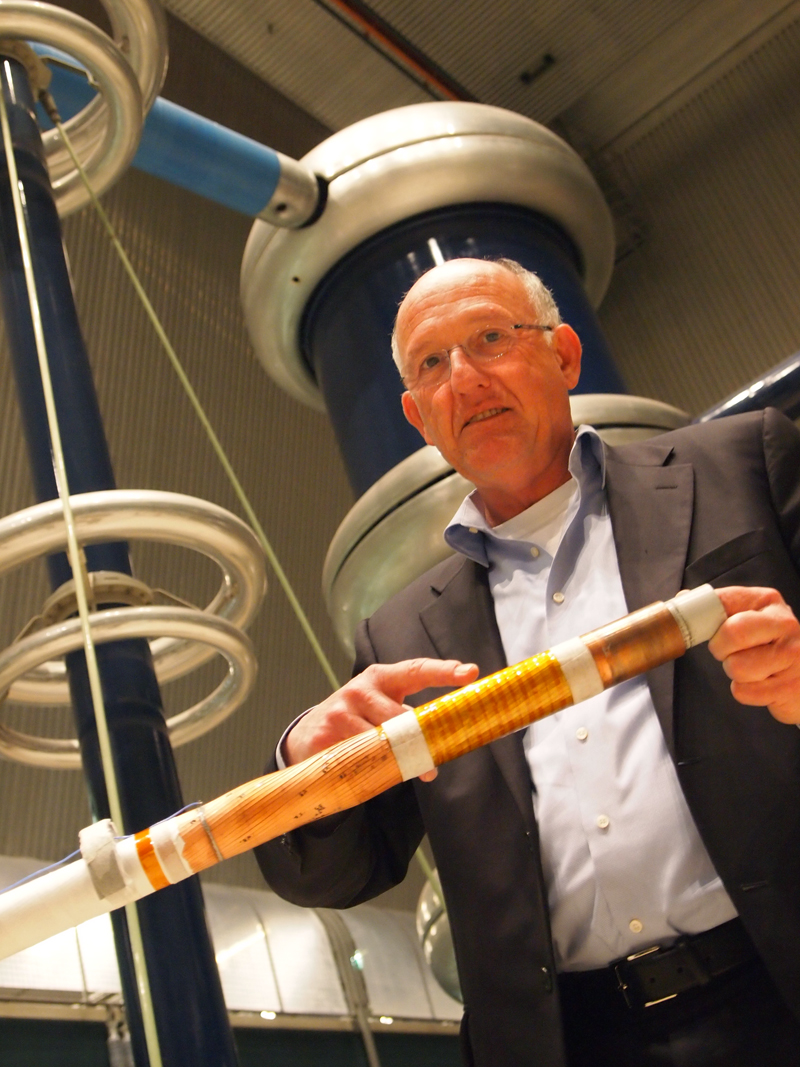
At the IEEE student lecture on the Desertec project (bringing solar and wind power into Europe on a large scale), Professor Johan Smit and Dr Oleg Chevchenko gave an update on the research and development on high power transmission cables.
Despite the complexity, there are two golden rules when scaling up power.
First, you go to higher voltages to reduce losses. In the Netherlands the maximum is 450 kV, but the next steps are 600 and 800 kV. Secondly, when transporting over long distances, you need to switch over from AC to DC (direct current). A nice example of both technologies is the Chinese 800 kV DC 1000 kilometre long overhead line connecting hydroplants with the cities Guangzhou and Shenzhen. It was built by Siemens and put into operation in 2009.
As Europe prepares for an energy transition from mainly fossil-based power to renewable power sources, it will need a new and advanced power transmission infrastructure to transport large amounts of energy over thousands of kilometres. This is what plans like EU Roadmap 2050 and Supergrid are all about.
Vorige week stemde de ChristenUnie in de Tweede Kamer voor de langstudeerregeling. De boete van drieduizend euro voor studenten die te lang over hun studie doen, gaat pas vanaf september 2012 in. Bovendien wordt op verzoek van de ChristenUnie een hardheidsclausule voor zieke en zwangere studenten toegevoegd. Ook regeringspartijen CDA en VVD, en PVV en SGP stemden in met de wet.
In de nieuwe Eerste Kamer heeft het kabinet straks behalve de SGP, waarschijnlijk ook de ChristenUnie nodig om een meerderheid te halen. Op 23 mei kiezen de leden van de Provinciale Staten de senaat.
De huidige Eerste Kamerfractie van de ChristenUnie zegt dat zij ‘het debat op zich laat afkomen’. Betekent dit dat het onzeker is of zij zal instemmen met de wet? “Als je van tevoren al een besluit neemt, heeft het debat geen zin meer”, reageert de woordvoerder. De besluiten van de Eerste en Tweede Kamerfractie “staan los van elkaar”.
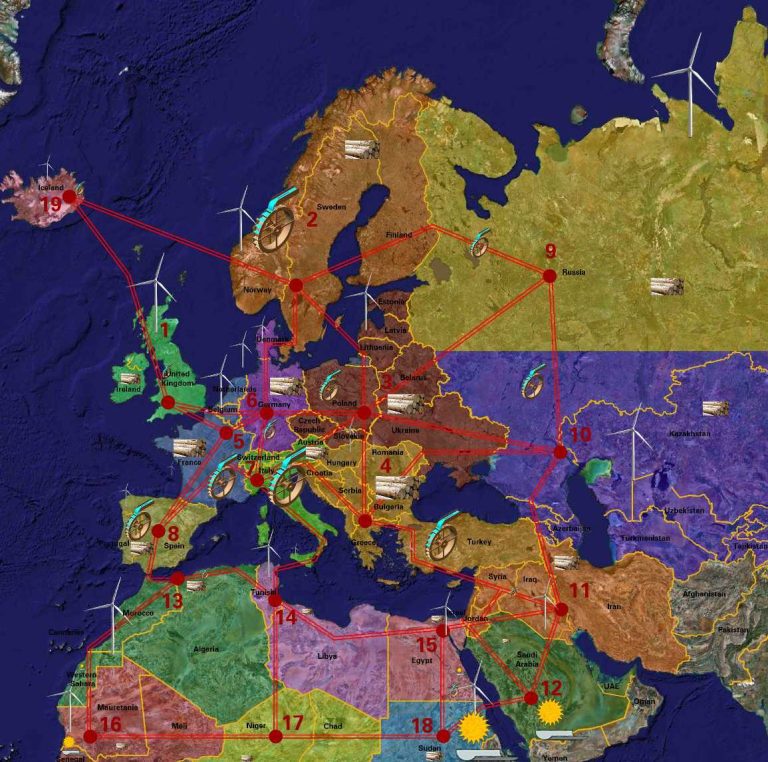 Supergrid
Supergrid
Supergrid
Supergrid is a visionary plan, which proposes an additional high-power, high-voltage, long-distance transmission grid to be superimposed on the current grids, hence the name Supergrid.
Links to wind and solar farms in Africa are part of the Supergrid, and so are numerous links over the Northsea and Atlantic Ocean. The first of those have been realised. NordNed for example (450 kV, 700 MW) links Netherlands and Norway, BritNed (450 kV, 1 GW) links Netherlands to the UK. Both these so called HVDC cables transport DC current and are linked to the AC net by large converter stations.
Another way to reduce the losses in power transmission is the use of superconducting cables. Prof. Jan Smit’s group is involved in a demonstration project of a nitrogen-cooled high temperature superconducting (HTS) cable over 6 kilometres in Amsterdam, together with Alliander and cable manufacturer NKT. In 2010 PhD-student Roy Zuijderduijn and Chevchenko achieved a ‘breakthrough’ in reducing the losses significantly below the threshold of 1 Watt/metre.
Eventually, Smit foresees a combination of 800 kV overhead power lines over land and superconducting DC cables for sea crossings. Lots of research still needs to be done to find out the best options and materials. Therefore it’s ironic that the impressive High Voltage Laboratory at EEMCS Faculty is on the nomination to be phased out. Instead, says Prof. Smit, the facility urgently needs an upgrade to 800 kV to remain competitive.

Do you have a question or comment about this article?
delta@tudelft.nl
Comments are closed.